
Introduction
Cloud computing offers flexibility, scalability, and cost savings, but not every organization uses the cloud in the same way. Some businesses are comfortable hosting everything on a public cloud, while others require dedicated infrastructure for security, compliance, or regulatory reasons. Many organizations also combine different cloud environments to balance performance, security, and cost.
To meet these different business requirements, cloud computing provides several deployment models. Each deployment model defines where the cloud infrastructure is hosted, who owns and manages it, who can access it, and how it is integrated with other computing environments.
In this article, you’ll learn about the four primary cloud deployment models—Public Cloud, Private Cloud, Hybrid Cloud, and Multi-Cloud. We’ll explore how each model works, its advantages and disadvantages, practical real-world examples, and when organizations should choose one deployment model over another.
What Are Cloud Deployment Models?
Cloud deployment models describe how cloud infrastructure is deployed, managed, and accessed. They help organizations choose the most suitable cloud environment based on security requirements, compliance regulations, performance expectations, scalability, and budget.
Each deployment model offers a different balance between control, flexibility, security, and cost. Choosing the right model depends on the organization’s business goals, workload requirements, and regulatory obligations.
Public Cloud
Infrastructure owned and managed by a cloud provider and shared among multiple customers.
Private Cloud
Dedicated cloud infrastructure used exclusively by a single organization.
Hybrid Cloud
Combines public and private cloud environments to meet different business needs.
Multi-Cloud
Uses services from multiple cloud providers to improve flexibility and reduce vendor dependency.
Deployment Models Differ In
There is no single deployment model that is best for every organization. The right choice depends on factors such as business size, security requirements, regulatory compliance, performance expectations, and budget. In the following sections, we’ll explore each deployment model in detail to understand where it fits best.
1. Public Cloud
A Public Cloud is a cloud environment where computing resources are owned, managed, and maintained by a third-party cloud provider. Multiple customers share the same physical infrastructure, while virtualization ensures that each customer’s applications and data remain isolated and secure.
Popular Public Cloud Providers
Advantages
- Low upfront cost
- Highly scalable
- Fast deployment
- Pay-as-you-go pricing
- Global availability
- No hardware maintenance
Limitations
- Less control over infrastructure
- Requires internet connectivity
- May not satisfy strict compliance regulations
Real Business Example
A startup launches an online shopping website using AWS. Instead of purchasing physical servers, the company rents virtual machines, storage, and databases from the cloud provider. During festive sales, cloud resources automatically scale to handle thousands of additional visitors without requiring new hardware.
Best For
Public Cloud is the most popular deployment model because it provides affordable, scalable, and globally available infrastructure without requiring organizations to own or maintain physical hardware.
2. Private Cloud
A Private Cloud is a cloud environment dedicated exclusively to a single organization. Unlike a public cloud, the infrastructure is not shared with other customers, giving the organization greater control, stronger security, and the ability to customize its environment according to business requirements.
A private cloud can be hosted in the organization’s own data center (on-premises) or managed by a third-party cloud provider. Regardless of where it is hosted, the infrastructure is reserved for one organization only.
Private Cloud Hosting Options
🏢 On-Premises
The organization owns and manages the servers inside its own data center.
☁️ Hosted Private Cloud
A cloud provider hosts and manages dedicated infrastructure exclusively for one organization.
Advantages
- Enhanced security and privacy
- Full control over infrastructure
- Easier regulatory compliance
- Dedicated computing resources
- Highly customizable environment
Limitations
- Higher infrastructure cost
- Requires experienced IT teams
- Greater maintenance responsibility
- Scaling may take longer than public cloud
Real Business Example
A national bank stores customer account information, transaction records, and financial applications in a private cloud. Because the infrastructure is dedicated to the bank, it can implement strict security controls and comply with financial regulations while protecting sensitive customer data.
Best For
A Private Cloud provides maximum control, security, and customization by dedicating cloud infrastructure to a single organization. It is the preferred deployment model for businesses that handle sensitive data or must comply with strict regulatory requirements.
3. Hybrid Cloud
A Hybrid Cloud combines both Private Cloud and Public Cloud environments into a single integrated infrastructure. Organizations keep sensitive workloads and confidential data in a private cloud while using the public cloud for customer-facing applications, additional computing capacity, or less critical workloads.
By combining the strengths of both deployment models, organizations achieve greater flexibility, improved security, and better cost optimization without sacrificing scalability.
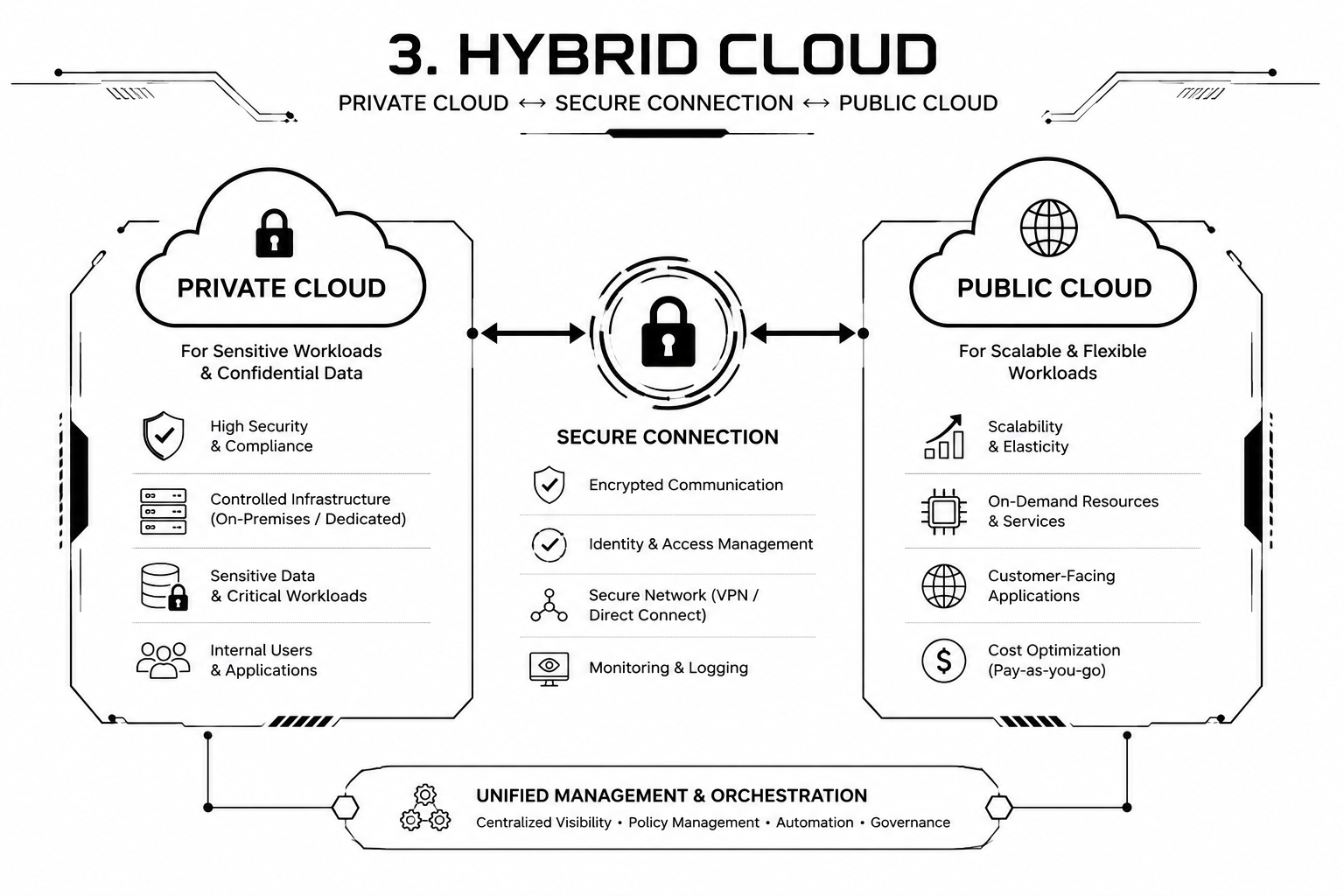
Private Cloud ↔ Secure Connection ↔ Public Cloud
Advantages
- Better protection for sensitive data
- Flexible workload placement
- Optimized infrastructure costs
- Improved disaster recovery
- Greater scalability during peak demand
Limitations
- More complex architecture
- Requires secure integration
- Higher management effort
- More difficult monitoring and administration
Real Business Example
A hospital stores electronic medical records and patient information in a private cloud to comply with healthcare regulations. Meanwhile, its appointment booking system, public website, and online consultation portal run on Microsoft Azure.
This approach keeps sensitive patient data secure while allowing public-facing services to scale automatically as demand increases.
Best For
Hybrid Cloud offers the best of both worlds by combining the security and control of a private cloud with the scalability and cost efficiency of a public cloud, making it an ideal choice for organizations with diverse workload requirements.
4. Multi-Cloud
A Multi-Cloud strategy uses services from two or more public cloud providers instead of relying on a single provider. Organizations select the best services from each cloud platform to improve flexibility, increase reliability, and avoid depending on a single vendor.
Unlike a Hybrid Cloud, a Multi-Cloud environment does not necessarily include a private cloud. Its primary goal is to combine the strengths of multiple public cloud providers to meet different business and technical requirements.
Example Multi-Cloud Strategy
Application Hosting
Identity Management
Artificial Intelligence & Machine Learning
Advantages
- Avoid vendor lock-in
- Choose the best service from each provider
- Better availability and resilience
- Improved disaster recovery
- Greater flexibility
Limitations
- More complex management
- Higher operational overhead
- Requires expertise across multiple platforms
- Cost monitoring becomes more challenging
Real Business Example
A global e-commerce company hosts its customer-facing website on AWS, uses Microsoft Azure Active Directory for employee authentication, and runs AI-powered product recommendation engines on Google Cloud.
Each cloud provider is selected because it offers the best services for a particular workload, allowing the company to maximize performance, innovation, and reliability.
Best For
Hybrid Cloud vs Multi-Cloud
| Hybrid Cloud | Multi-Cloud |
|---|---|
| Combines Private + Public Cloud | Uses multiple Public Cloud providers |
| Focuses on balancing security and scalability. | Focuses on flexibility and avoiding vendor lock-in. |
Multi-Cloud enables organizations to leverage the strengths of multiple cloud providers, improving flexibility, resilience, and innovation while reducing dependence on a single vendor.
Comparison of Cloud Deployment Models
Each cloud deployment model offers different levels of ownership, security, scalability, and control. The following comparison table highlights the key differences to help you choose the deployment model that best fits your organization’s requirements.
Quick Summary
Public Cloud focuses on affordability and scalability, Private Cloud provides maximum security and control, Hybrid Cloud balances private and public environments, while Multi-Cloud leverages multiple cloud providers to improve flexibility and reduce vendor dependency.
Which Deployment Model Should You Choose?
There is no single deployment model that is suitable for every organization. The right choice depends on factors such as budget, security requirements, regulatory compliance, scalability, and business objectives. The following recommendations can help you select the most appropriate cloud deployment model for different business scenarios.
Key Recommendation
Choose a Public Cloud if cost and scalability are your priorities, a Private Cloud if security and compliance are critical, a Hybrid Cloud if you need a balance between security and flexibility, and a Multi-Cloud if you want to leverage the strengths of multiple cloud providers while avoiding vendor lock-in.
Why Understanding Deployment Models Matters
Selecting the appropriate cloud deployment model is one of the most important decisions an organization makes when adopting cloud computing. The choice directly influences how applications are deployed, how data is protected, how infrastructure is managed, and how efficiently the business can grow in the future.
Choosing the Right Deployment Model Affects
Protecting sensitive data and business assets.
Delivering reliable and responsive applications.
Meeting industry and government regulations.
Balancing operational expenses and investment.
Keeping business operations running with minimal downtime.
Recovering systems and data after unexpected failures.
Supporting future growth without major infrastructure changes.
Final Thought
There is no single cloud deployment model that is perfect for every organization. The best choice depends on your business goals, technical requirements, security expectations, regulatory obligations, budget, and long-term growth plans. Understanding the strengths and limitations of each deployment model enables organizations to build secure, scalable, and cost-effective cloud solutions.
Conclusion
Cloud deployment models help organizations determine how their cloud infrastructure should be deployed, managed, and secured. Each deployment model is designed to address different business requirements, whether the goal is reducing costs, improving security, meeting regulatory compliance, or supporting global scalability.
Public Cloud offers affordability and virtually unlimited scalability, making it an excellent choice for startups and rapidly growing businesses. Private Cloud provides maximum control, customization, and security for organizations handling sensitive information. Hybrid Cloud combines the strengths of public and private environments to balance security with flexibility, while Multi-Cloud enables organizations to leverage the best services from multiple cloud providers, reducing vendor dependency and increasing resilience.
Key Takeaway
There is no universal cloud deployment model that fits every organization. Selecting the right deployment strategy requires careful evaluation of your business goals, security requirements, compliance obligations, budget, and future growth plans. A well-informed decision helps organizations build cloud environments that are secure, scalable, reliable, and cost-effective.
Next in This Series
In the next article, we’ll explore Cloud Service Models (IaaS, PaaS, and SaaS). You’ll learn how each service model works, who manages different parts of the infrastructure, their advantages and limitations, and how organizations choose the right model for building, deploying, and managing modern cloud applications.